
Why is never just about the answer
Finding your Artist Statement or how many times do you need to ask why?
There is a particular kind of silence that appears when an artist is asked to write an Artist Statement.
You can probably tell me what you make. You know whether you work in watercolour, oils, photography, sculpture or mixed media. You can describe the subjects that repeatedly appear in your work. You know which materials you prefer, what scale you work at and perhaps even which artists have influenced you.
Then somebody asks a deceptively simple question.
Why?
- Why do you paint this?
- Why do you keep returning to these places?
- Why does this particular subject matter to you?
- Why should these works exist together?
Suddenly, describing the work is no longer enough. I know this discomfort very well because I have rewritten my own Artist Statement many times. Each version was true when I wrote it. That is important. I do not look back at my earlier statements and think I was wrong. I think I could only articulate what I was able to see in my practice at that particular moment. For a long time, I spoke about architecture, history, urban landscapes, memory, light and the relationship between past and present. All of those things genuinely existed in my paintings. They still do. What I could not yet see clearly was the question underneath them. That took longer.
An Artist Statement is not an explanation of your paintings
One of the most common problems with Artist Statements is that they simply translate the visible image into words. My paintings explore architecture. I am inspired by light. I use watercolour because I love its transparency. I am interested in history and memory.
There is nothing necessarily false about any of those sentences. The problem is that thousands of artists could write versions of them.
If I can discover almost everything in your statement by looking at the paintings for thirty seconds, the text is not yet doing enough.
An Artist Statement should give me access to something the image alone cannot immediately tell me.
- What keeps pulling you back?
- What are you testing?
- What tension refuses to disappear?
- What are you trying to understand through making?
- What question has followed you from one work into another, perhaps before you even realised it was there?
This is where asking why can become useful.
The first why is rarely the deepest one
Suppose I ask myself why I paint architecture. Because I am fascinated by old buildings. Why? Because they contain history. Why does that matter to me? Because I am interested in what remains from the past and how it continues to exist within the present. Why does that matter? Now the conversation is beginning to change. I am no longer talking primarily about buildings. Perhaps I am talking about time. Perhaps memory. Perhaps permanence. Perhaps belonging. Perhaps the strange coexistence of what remains and what disappears. Ask again and another layer may appear.
This principle resembles the Five Whys method associated with Toyota and root cause analysis. Its original purpose was practical problem solving rather than artistic introspection, but I find the underlying mechanism useful. Instead of accepting the first plausible explanation, you continue questioning the answer itself.
For an artist, five is not a magical number. Sometimes the second why reveals something immediately. Sometimes the fifth does. Sometimes you ask the same question for several years and realise that every answer was only another layer.
That does not mean the method has failed. The difficulty is that artistic practice does not necessarily contain one root cause waiting patiently to be discovered.
Be careful with the biggest question
There is another problem I have encountered. Why do you create? It sounds profound. It can also be so enormous that it becomes almost useless. Why do I create?
- Because I need to.
- Because it helps me understand the world.
- Because I have always created.
- Because beauty matters to me.
- Because painting gives me a language.
All of these answers may be deeply sincere. They may also tell a curator very little about the actual practice. I find smaller questions much more productive.
- Why did I choose this subject rather than another?
- Why have I painted this tension repeatedly?
- Why am I attracted to this particular kind of space?
- Why do I keep placing the viewer here?
- Why does this part of the image remain unresolved?
- Why am I resisting clarity?
- Why does this new painting feel more truthful to me than the previous one?
These questions bring us closer to the work. The difference is subtle but important. Why do I make art? asks for an explanation of your existence as an artist. Why does my practice keep doing this? asks you to pay attention. For an Artist Statement, attention is often far more useful than autobiography.
My own statement kept changing because my work kept teaching me something
My earlier work was strongly connected with architecture, heritage and urban memory. I was interested in the traces of history carried by buildings and places, particularly in environments where different periods seemed to coexist. That was real.
If somebody had told me at the time that my practice was actually about liminality, thresholds and transitional states, I am not sure I would have recognised myself in that language. I had not arrived there yet. But paintings accumulate evidence. Looking across later works, I began noticing something. I was repeatedly drawn not simply to architecture itself, but to relationships between states. Fixed structures against moving water. Historic forms inside contemporary life. Solidity dissolving into reflection. Presence beside absence. Stillness containing the possibility of movement.
Eventually another question became visible: What becomes possible in the spaces between?
I did not invent that sentence first and then manufacture paintings to illustrate it. The paintings came first. The question emerged because I kept looking at what I had already made and asking why certain visual and emotional conditions continued returning. That distinction matters enormously to me.
An Artist Statement should not impose intelligence upon work from the outside. It should articulate the intelligence already developing inside the practice.

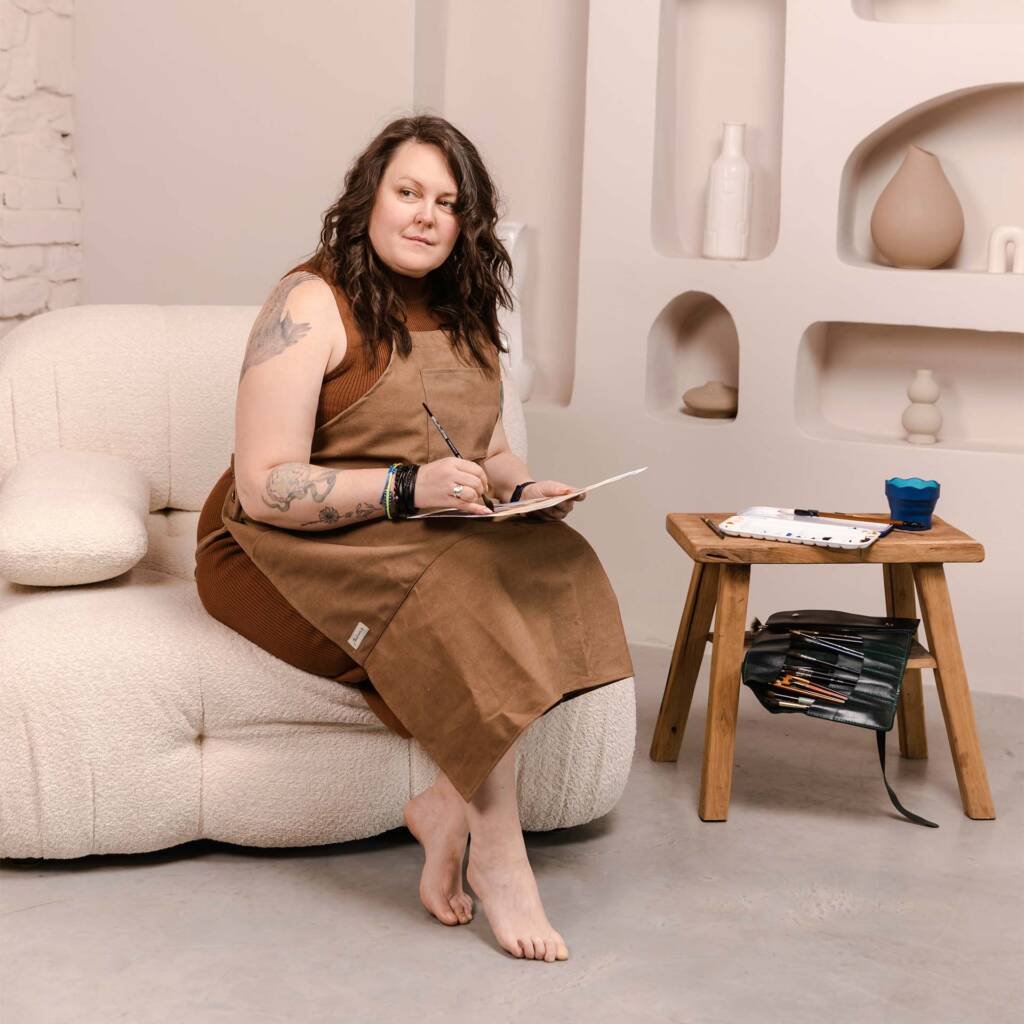
Sometimes the answer is in the repetition
Artists often search for their statement by staring at a blank document. I would rather begin by staring at the work. Put ten or fifteen pieces together. Preferably works from more than one year. Do not immediately ask which are best. Look for recurrence. What keeps appearing?
Perhaps it is a physical form. Windows. Water. Empty chairs. Bodies turned away. Repeated grids. Fragments of landscape. Then look beyond subject matter. Perhaps the real repetition is distance. Perhaps every figure is inaccessible. Perhaps every landscape contains an interruption. Perhaps your interiors are always waiting for somebody who never arrives. Perhaps your colours repeatedly move towards a particular emotional temperature. Perhaps you keep building order and then disrupting it. These repetitions are evidence. Ask why they are there. Then ask why the answer matters. Your statement may already be hiding inside the pattern.
Your materials are part of the thinking
Medium belongs in an Artist Statement when the material itself participates in the idea. Saying, “I work in watercolour on cotton paper” gives information. Asking why watercolour is necessary to the work may reveal something else. For me, watercolour can hold control and unpredictability in the same painting. I can construct something architectural and precise, then allow water, pigment and gravity to destabilise it. Edges can exist and disappear. Reflections can become almost indistinguishable from the things they reflect.
At that point, technique is no longer a separate paragraph about craftsmanship. It is part of the research.
The same principle applies to any medium. Why clay rather than bronze? Why found photographs? Why repetition? Why stitching? Why monumental scale? Why something deliberately temporary? Why does the material behave in a way your subject requires?
If changing the medium would fundamentally change the meaning, that relationship probably belongs somewhere in your thinking about the statement.
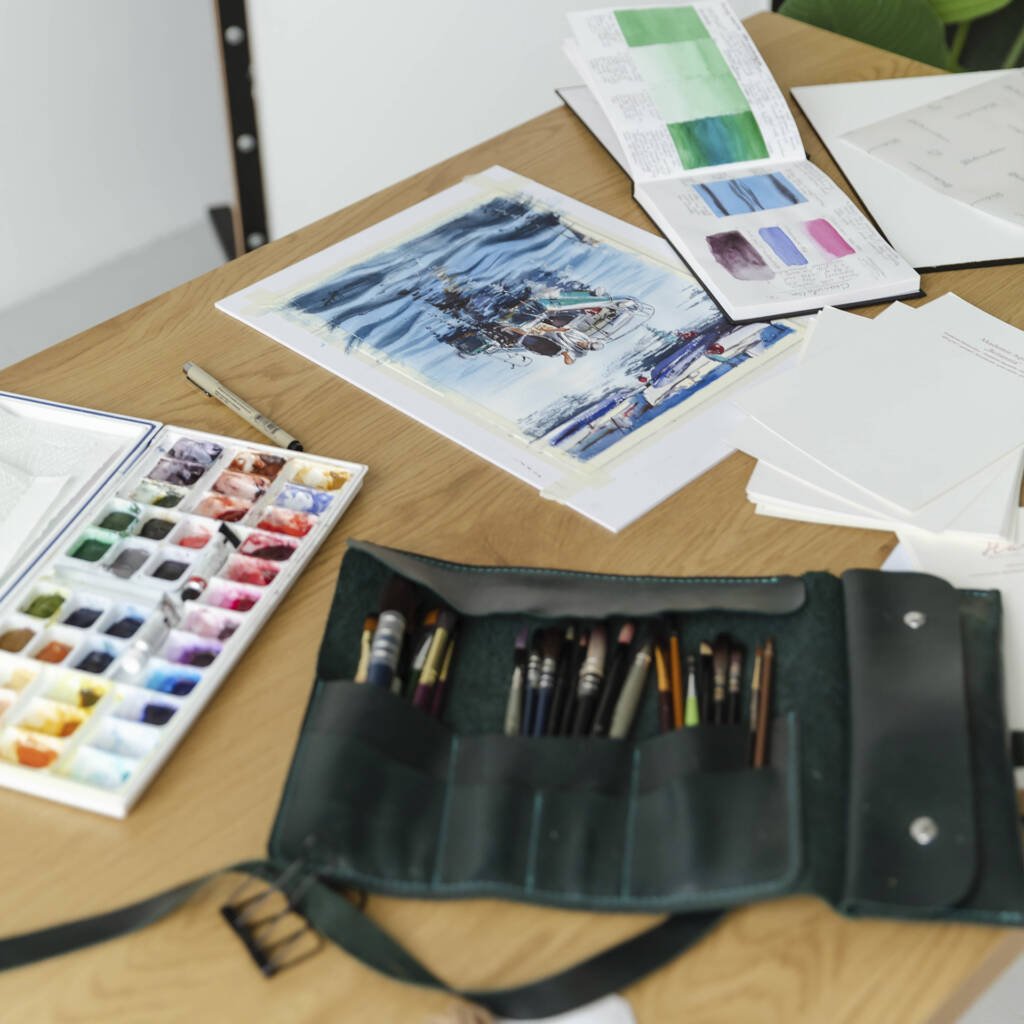
Biography matters when it changes the way you see
Another temptation is to turn an Artist Statement into autobiography. Your life undoubtedly enters your work. Mine does too. Migration, displacement, the cities in which I have lived and the experience of rebuilding a relationship with place have affected the way I see.
But not every important event in my life belongs in my Artist Statement. I ask whether the biographical information helps another person understand something specific about the work. If it does, it has a reason to be there.
If it merely explains why I am an interesting human being, it probably belongs in my biography instead. This distinction can be difficult because artists naturally want to explain themselves when asked to explain their art. They are not quite the same task.
Write from evidence before reaching for art language
There is a strange vocabulary that appears the moment people begin writing Artist Statements. Suddenly everything explores, interrogates, navigates, challenges, disrupts and invites dialogue.
Sometimes those are exactly the right words. Sometimes they are borrowed seriousness. Before reaching for any of them, I would write plainly.
- What am I actually doing?
- What am I noticing?
- What appears repeatedly?
- What changed recently?
- What am I uncertain about?
- Which painting feels closest to where my practice is going?
- Which work feels as though it belongs to an older version of the practice?
- What am I trying to understand that I cannot simply answer in words?
Plain answers are useful raw material. Language can become more precise later. The purpose of an Artist Statement is not to make simple work sound complicated. It is to make complex thinking accessible without flattening it.
A statement needs to say what, how and why, but not equally
If I were trying to understand an unfamiliar artist through a short statement, I would want to come away knowing three things. I want to understand what territory the practice occupies. Not necessarily a list of subjects, but the concerns, questions or tensions around which the work gathers.
I want some understanding of how the artist works, particularly where process, material or formal decisions are connected with those concerns. And I want to sense why this investigation matters enough for the artist to continue pursuing it. These elements do not need separate headings. In a good statement they usually weave through one another.
What I do not need is the artist’s entire life story, every exhibition, a list of adjectives describing the work, an explanation of every symbol or instructions telling me what I am supposed to feel. Leave something for the work to do.
Your Artist Statement is allowed to become obsolete
This may be the most liberating thing I have learned about writing one. An Artist Statement is not a contract with your future self. You are allowed to outgrow it. In fact, if your practice is alive, I would be surprised if the same statement described it perfectly forever.
A statement records your current ability to articulate what the work is doing. Six months later, another painting may disturb that understanding. A new body of work may expose a contradiction. Something you considered secondary may become central. Then you write again. This is not inconsistency. It is evidence that the practice is moving. I now find my old statements valuable precisely because I can see the progression between them. They contain earlier answers to questions I am still asking.
- Some answers survived.
- Some became more precise.
- Some disappeared completely.
And occasionally a sentence I wrote years ago suddenly makes more sense than it did when I wrote it.
What a curator actually needs from an Artist Statement
Finding the language of your practice is only half the job. The other half is learning to present that thinking in a form another professional can actually use. Curators, selectors and organisations often read a large number of applications within a limited period of time. Your Artist Statement therefore needs to communicate quickly. It should not require three pages before the reader understands what your work is concerned with.
There is no universal word count, because every opportunity sets its own requirements. Some ask for 150 words, others 200, 250 or 300. If a word limit is given, follow it exactly. For my own professional material, I find it useful to keep a strong core version of approximately 200 to 300 words, then adapt it for each application.
That last part matters. I do not think an Artist Statement should be copied unchanged into every submission. A residency, a conceptual exhibition, an art prize and a gallery application may all need slightly different emphasis. The practice remains the same, but the reader may need a different entrance into it.
In most cases, an Artist Statement is written in the first person because it is the artist speaking about the practice. A biography is usually written in the third person because it describes the artist professionally. They serve different purposes and should not become versions of the same text.
A statement does not need to list exhibitions, awards or publications. That information belongs in your CV and biography. It does not need to explain where you were born unless that information genuinely affects the work. It does not need to tell the reader that your paintings are “powerful”, “unique”, “beautiful” or “thought provoking”. Let the work and its professional context establish those things.
What the reader does need is a clear sense of the territory of the practice, the questions or tensions you return to, the way your materials or process relate to those concerns, and enough context to understand why the work takes the form it does.
I would also avoid explaining individual paintings unless the application specifically asks for it. An Artist Statement normally speaks about the practice or current body of work, not one isolated object.
Plain language is usually stronger than inflated art language. Specialist terminology is perfectly legitimate when it is genuinely necessary, but complexity of thought does not require complexity of sentence structure. A curator should not have to decode the writing before they can begin thinking about the work.
A useful test is to remove the images and read the statement by itself. Does it tell me something specific enough that it could only reasonably belong to your practice? Then put the images back. Does the text deepen what I can see without simply describing it?
If it does both, the statement is probably doing its job.
I keep more than one version of my Artist Statement. A short version may be around 100 words, a standard version around 200 to 300, and a longer working version can hold ideas that are still developing. The longer version is not necessarily something I send to curators. It is where I think. The shorter versions are where I edit.
So how many times should you ask why?
As many times as the question remains productive. That may be five. It may be two. It may be fifty. The purpose is not to excavate your psyche until you finally discover one perfect reason behind everything you have ever created. There may be no single reason. The purpose is to move beyond the first convenient answer.
Ask why until the language becomes more specific rather than more abstract. Ask until you stop describing only the visible subject and begin recognising the concern underneath it. Ask until different works start speaking to one another.
And know when to change the question. Sometimes “why?” begins producing another why, and another, and another. At that point I find other questions more useful.
- What keeps returning?
- What am I noticing now that I did not notice before?
- Where is the tension in the work?
- What has changed?
- What am I still unable to resolve?
- What question does the work leave open?
That last one matters particularly to me. I used to think an Artist Statement should demonstrate that I understood my practice. Now I think it should demonstrate that I am paying attention to it. There is a difference. An artist does not necessarily stand outside the work holding all the answers. Sometimes we are inside the research ourselves. The painting knows something before we have language for it. Perhaps that is why writing an Artist Statement can feel so difficult. You are trying to put language around something that may still be becoming. So write the statement you can write now.
Look closely at the work in front of you. Follow its repetitions. Question your easy answers. Pay attention to your materials. Separate biography from practice. Find the questions that genuinely belong to the work. Then allow yourself to return to it. Your fifth Artist Statement may finally illuminate something your first one could not see. And your sixth may prove that the fifth was only the beginning.
Share this article :
INSPIRED POST
Building an artist career: beyond the canvas
01/04/2026

How I organised my first solo art exhibition
10/10/2025
Becoming visible: my solo art
09/23/2025
The flavour of belonging:
08/21/2025
From silence to Castalia…
08/08/2025