Biography
A contemporary artist whose practice explores what becomes possible in the spaces between.
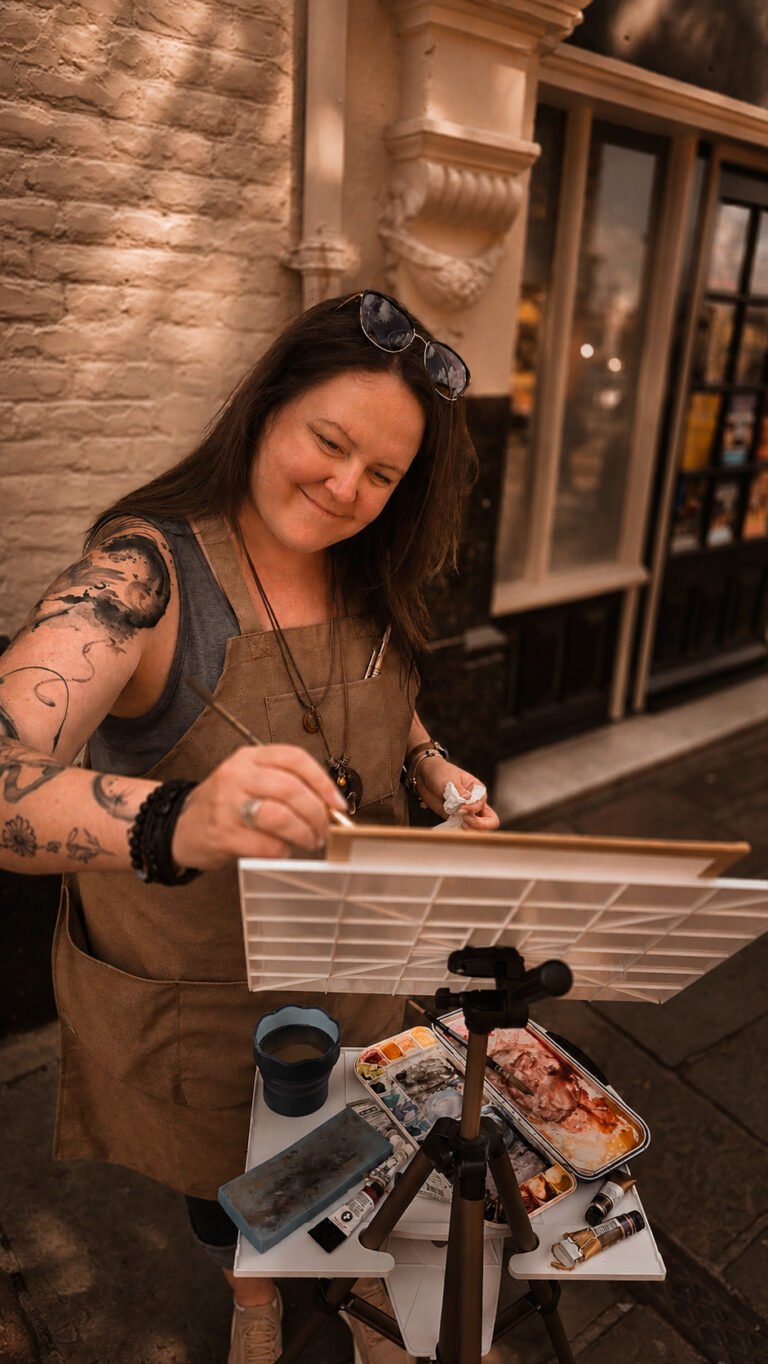
Aliya Bodnar (b. 1986, Surgut) is a contemporary artist based in Kent, United Kingdom, working primarily in watercolour. Her practice combines painting and writing as parallel forms of enquiry, each informing the other while investigating questions of perception, identity and human experience.
Having lived across several countries and cultures, Bodnar’s work is shaped by long-term observation rather than documentation. She develops paintings through sustained engagement with particular places, allowing repeated visits, changing light and accumulated experience to influence the final work.
Although working in watercolour, her paintings challenge many of the conventions associated with the medium. Built through multiple layers, controlled pigment behaviour and carefully considered structure, they prioritise atmosphere, psychological space and quiet complexity over direct description.
Alongside her studio practice, Bodnar writes reflective essays that extend the same enquiry through language, exploring the relationship between observation, memory and the ways we construct meaning. Together, these parallel practices form an ongoing investigation into contemporary experience through both image and text.
She lives and works in Kent, where her current practice continues to develop through painting, writing and collaborative engagement with the regional artistic community.
ALIYA BODNAR
A contemporary artist working primarily in watercolour
Beyond Biography
Every artist is expected to have a biography.
In contemporary practice, a biography serves as a professional introduction. It outlines the artist’s background, the focus of their practice and the context in which their work is developing. Written in the third person, it provides a concise portrait of the artist’s position within the wider field.
It is useful.
But perhaps it answers a different question.
It tells us where someone is.
It rarely tells us how they arrived at the way they see the world.
The route through different countries, professions and experiences explains only part of a life. Two people may share similar histories and arrive somewhere entirely different because they have learned to pay attention to different things.
For Bodnar, contemporary watercolour painting did not begin with the decision to become an artist. It began much earlier, through observation. Through an increasing curiosity about the moments that quietly exist between certainty and change, between memory and the present, between what remains and what continues to evolve.
This way of seeing became the foundation of both her original watercolour paintings and her writing.
Rather than separating biography from artistic practice, her work suggests that identity is formed less by the events we experience than by the way we continue looking at the world after they have passed. These ideas continue throughout her Portfolio, where architecture, memory and place become recurring themes explored through painting.
Perhaps that is why no biography can ever feel complete. It can describe the journey. But it cannot fully describe the person who continues to travel.
Readers interested in the thinking behind the paintings can also explore her Practice, where she reflects on observation, artistic process and the questions that continue to shape her work.
A Way of Seeing
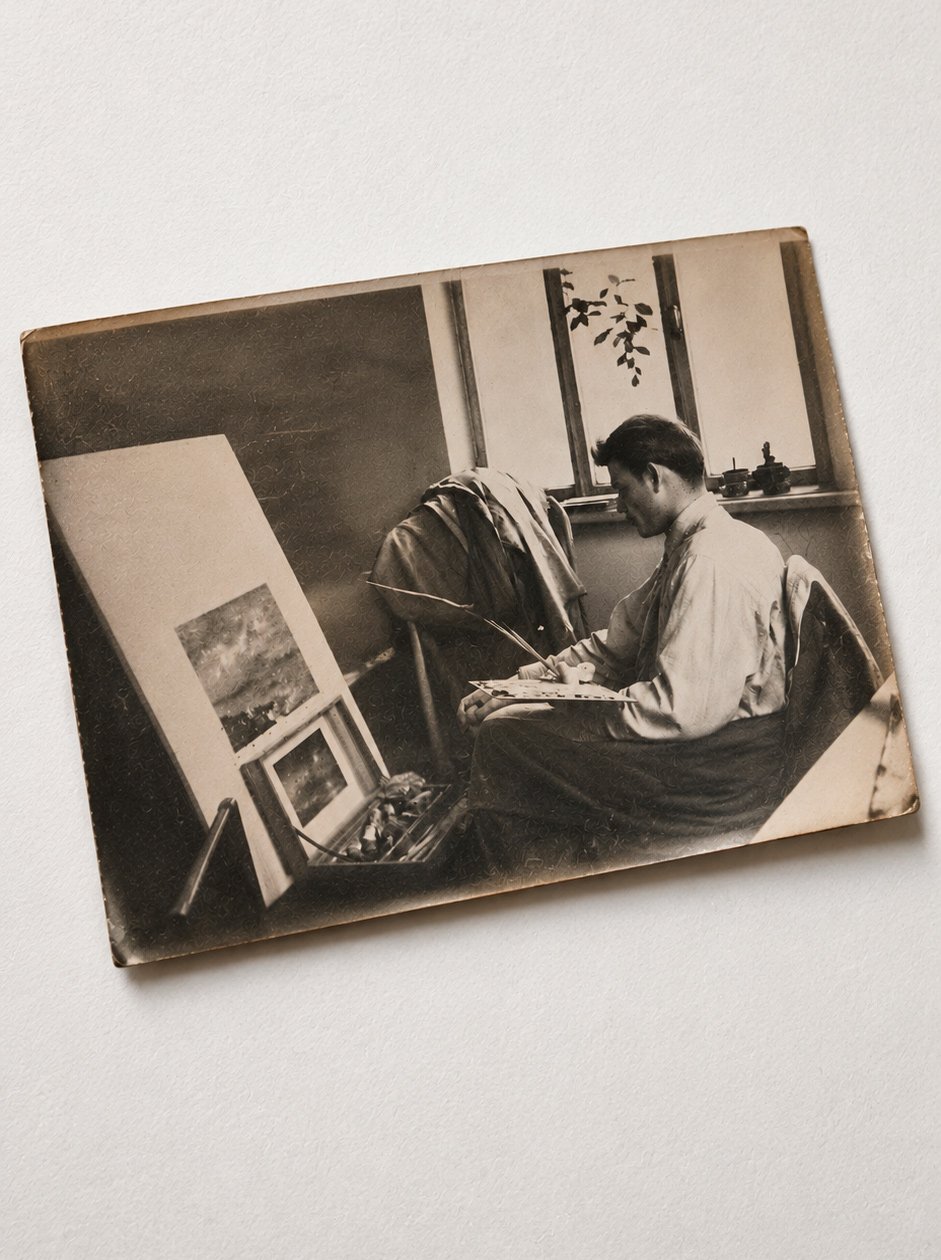
A few years ago, Bodnar came across a family photograph taken in 1957. It shows her grandfather sitting quietly in the small improvised studio she still remembers from childhood, drawing. She remembers the smell of paint, the shelves filled with jars and brushes, and the feeling that this little room belonged to a world of its own. The photograph did not introduce her to someone unfamiliar. It returned her to someone she had loved all her life.
What surprised her was something else entirely.
Looking at the photograph, she realised that what felt so familiar was not simply the man sitting there, but the way he seemed to be looking at the world. It is difficult to explain how a single image can reveal something that has always been present, yet that was precisely the feeling. The photograph did not uncover a forgotten family story. It gave language to a quiet recognition.
Perhaps that is why she has never thought of this photograph as evidence that artistic ability somehow passes from one generation to the next. That has never interested her. What stayed with her was a different possibility altogether. Perhaps what is passed on is not a profession, nor talent, nor even the decision to become a contemporary artist. Perhaps what travels much more quietly through generations is a way of paying attention. A particular kind of curiosity. A willingness to stop before walking on. An instinct to notice what rarely asks to be noticed.
Looking back now, the photograph feels less like the beginning of her artistic practice and more like the moment she recognised something that had been quietly shaping it all along. That same way of seeing continues to shape her original paintings, where observation becomes the starting point for every work.
Observation
Every day offers thousands of things to look at, yet remarkably few that we truly notice. Most of what surrounds us dissolves into familiarity. Streets become routes. Historic buildings become landmarks. Reflections become part of the background. We stop seeing them not because they have changed, but because we believe we already know them.
For Bodnar, contemporary watercolour painting grew out of a growing suspicion that the familiar is rarely as familiar as it appears. The longer she returned to the same places, the more they resisted certainty. Light changed. Weather changed. Time changed. More surprisingly, so did the person standing there, looking.
Observation gradually became less about recording what was visible and more about remaining present long enough for something else to emerge. A quiet relationship between light and architecture. A reflection that existed for only a few seconds. A moment of stillness before a station filled with people. The ordinary revealing itself as something far less ordinary than it first appeared.
This way of working has little to do with searching for extraordinary places. It begins with the belief that every place contains more than it first reveals, provided we are willing to stay with it a little longer. That approach continues to shape Bodnar’s painting practice and the original watercolour paintings that emerge from it.
The paintings come afterwards. Attention comes first.
Questions Before Paintings
People often assume that paintings begin with an idea, a place or a subject. Bodnar gradually realised that this had never been true for her. Long before a sheet of paper appears on the table, there is usually a question that refuses to leave.
Sometimes it begins with something almost impossible to define. A feeling that lingers after leaving a place. A moment that continues to return long after it has passed. A quiet sense that something familiar is asking to be looked at differently. Rather than trying to answer these questions, she has learned to stay with them.
Over time, she noticed that the paintings themselves were never searching for conclusions. They became another way of thinking. Another way of remaining with uncertainty long enough for a different understanding to emerge. This process continues to shape her contemporary painting practice.
Perhaps that is why the same questions continue to appear throughout her work. What changes when two realities exist together? What remains when certainty disappears? What becomes possible in the spaces between? These are not questions to solve, but questions to inhabit.
Each original watercolour painting begins as part of that conversation. A harbour, a railway station, a reflection or a quiet historic street may appear to be the subject, yet they are simply places where the enquiry becomes visible. The image does not provide an answer. It allows the question to continue.
A Life Interrupted
Some lives unfold in a straight line. Others are shaped by interruption.
Looking back, Bodnar realises that many of the experiences that quietly transformed her way of seeing arrived uninvited. Illness. Loss. Violence. War. Leaving one country and beginning again in another. None of these experiences was ever sought, and none of them became the subject of her contemporary paintings.
What changed was something less visible. They altered her relationship with certainty.
Plans became more provisional. Identity became less fixed. The ordinary acquired a different weight. A quiet morning, a familiar street or the simple act of returning to the same place no longer felt insignificant. They became reminders that life is constantly being rewritten, often without asking our permission.
Perhaps this is why her painting practice rarely searches for dramatic moments. It lingers instead in what remains afterwards. The stillness that follows disruption. The slow rebuilding of trust. The quiet resilience that rarely announces itself, yet quietly continues.
Pain has never become an identity within her practice.
If anything, it has become a companion whose presence changes over time. Sometimes distant. Sometimes impossible to ignore. Never entirely absent. Learning to live alongside it has been less like winning a battle than learning an unfamiliar dance, one that keeps changing its rhythm but never quite comes to an end.
Seen this way, original watercolour painting is not an escape from interruption. It is one of the ways life gradually becomes whole again.
The Spaces Between
There is a moment in almost every long artistic practice when the work begins to explain the artist, rather than the artist explaining the work.
For Bodnar, that moment arrived unexpectedly.
For years she believed she was painting different subjects. Historic streets. Railway stations. Harbours. Reflections. Flowers. They seemed unrelated, connected only by personal experience and the places that happened to cross her path. Looking back now, she realises that none of them had ever been the real subject.
The paintings had simply arrived there before she did.
Only after years of returning to the same questions did a different pattern begin to reveal itself. What kept drawing her back was never architecture, water or even memory. It was the invisible relationship that exists whenever two realities meet without trying to defeat one another. A place becomes meaningful because someone stands within it. A reflection exists because two worlds occupy the same surface. The past continues to shape the present without asking it to become the past again. Even twilight refuses to choose between light and darkness, allowing both to exist long enough for something entirely new to appear.
Perhaps this is why her paintings have never searched for answers. They have always searched for relationships. Not because relationships resolve uncertainty, but because they make it possible to remain inside it without needing to simplify it.
Looking back, Bodnar no longer thinks of her paintings as images of places. She sees them as attempts to understand what becomes possible when we stop asking which reality is true, and begin asking what can emerge when different realities are allowed to exist together.