Hundred Shades of Green: An English Forest at Dawn
Original Watercolour Painting
● Available for cquisition
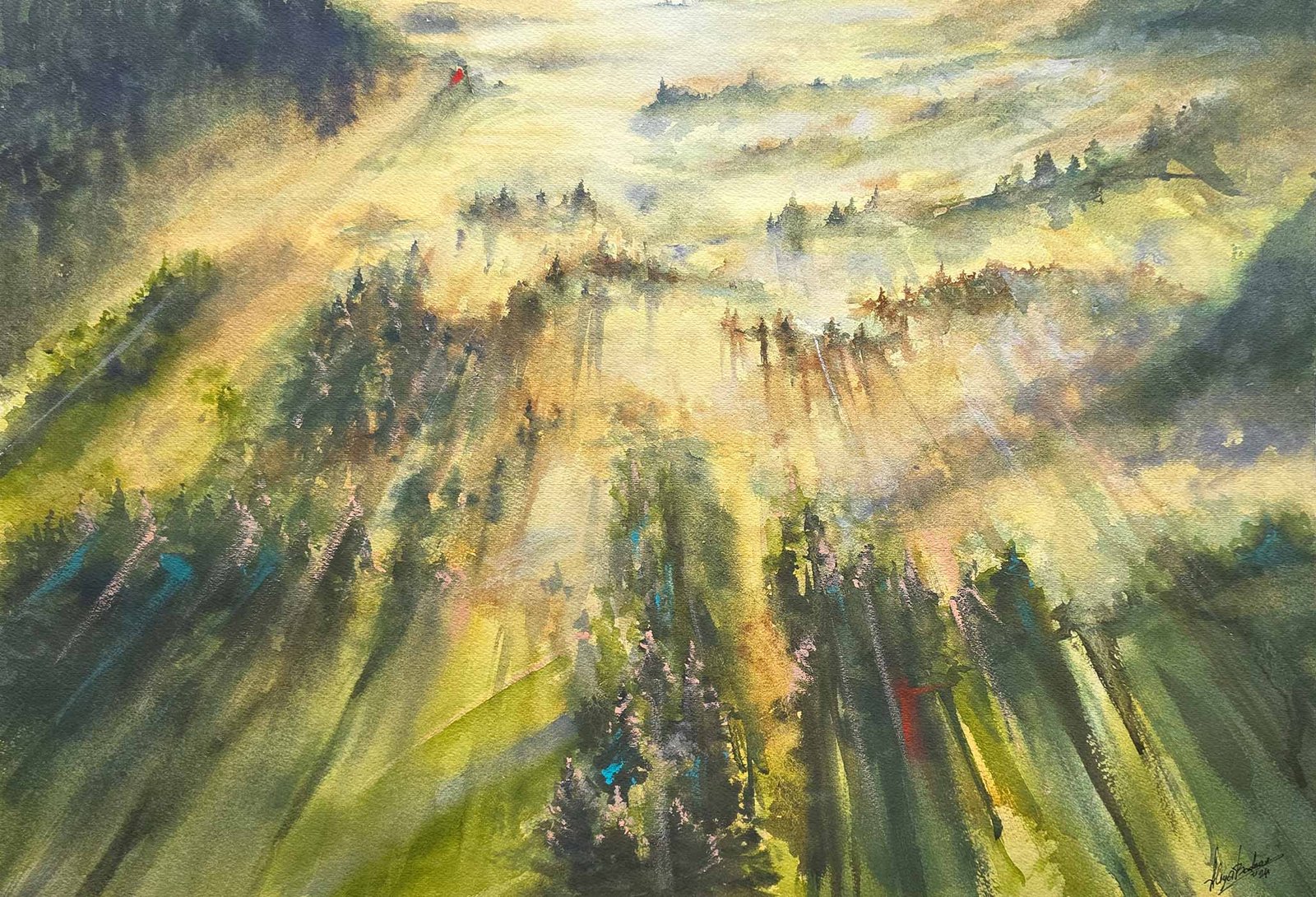
- Artist : Aliya Bodnar
- Series : Chapter III `Presence`
- Media : Watercolour on 100% cotton paper
- Size : 36cm x 51cm
01
Introduction
HUNDRED SHADES OF GREEN: AN ENGLISH FOREST AT DAWN
Sometimes the longer we look at something familiar, the less certain we become of what we see.
At first glance, Hundred Shades of Green: An English Forest at Dawn is a landscape of trees, morning mist and sunlight moving through an English woodland. Yet what drew me to this scene was the difficulty of separating one element from another.
The trees appear as recognisable forms, but their shadows extend across the ground, becoming almost as present as the trees themselves. Light passes unevenly through the woodland, illuminating some areas while leaving others partially concealed. What initially seems solid begins to dissolve into atmosphere.
I was interested in how the forest could exist in several states at once. It feels still, yet the shifting light suggests continuous change. Some forms remain clearly defined, while others become difficult to distinguish from the colours and shadows surrounding them.
As I worked on the painting, I became increasingly aware that looking more closely did not necessarily bring greater certainty. Instead, it revealed relationships I might otherwise have overlooked.
The forest itself had not become unfamiliar. What changed was the way I was paying attention to it.
Perhaps presence begins when we allow the familiar to remain unresolved for a little longer.
02
WHEN THE FAMILIAR BECOMES UNCERTAIN.
The longer I worked on Hundred Shades of Green: An English Forest at Dawn, the more I became interested in the relationship between the trees and everything that seemed to exist around them.
The composition is shaped not only by the physical forms of the woodland, but also by the shadows they cast and the light passing between them. Some trees appear as dark, concentrated masses, while their elongated shadows stretch across the forest floor, creating forms that are almost as visually significant as the trees themselves.
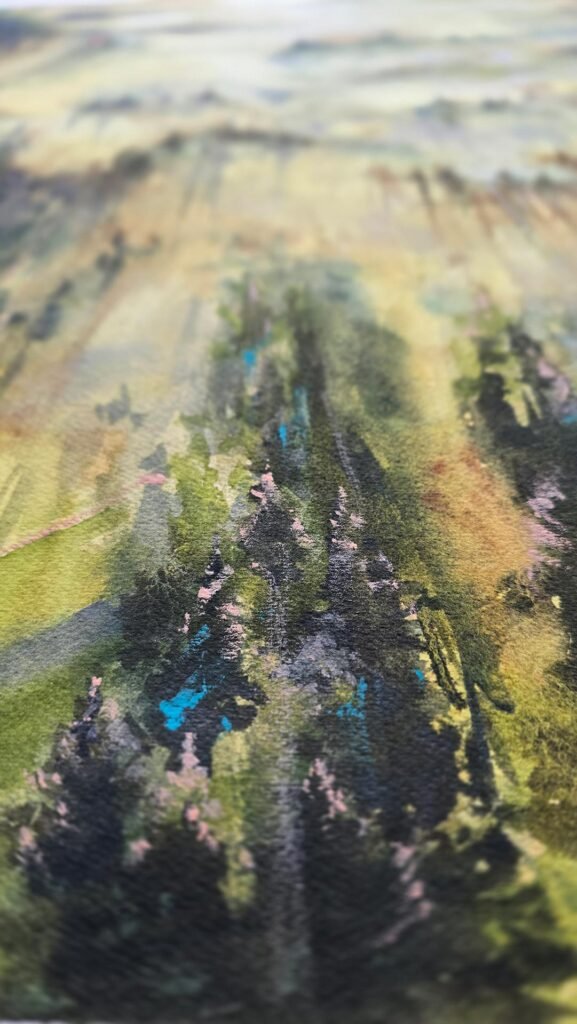
In some areas, the distinction between a tree, its shadow and the atmosphere surrounding them becomes uncertain. What appears solid from a distance begins to fragment into colour and movement when examined more closely.
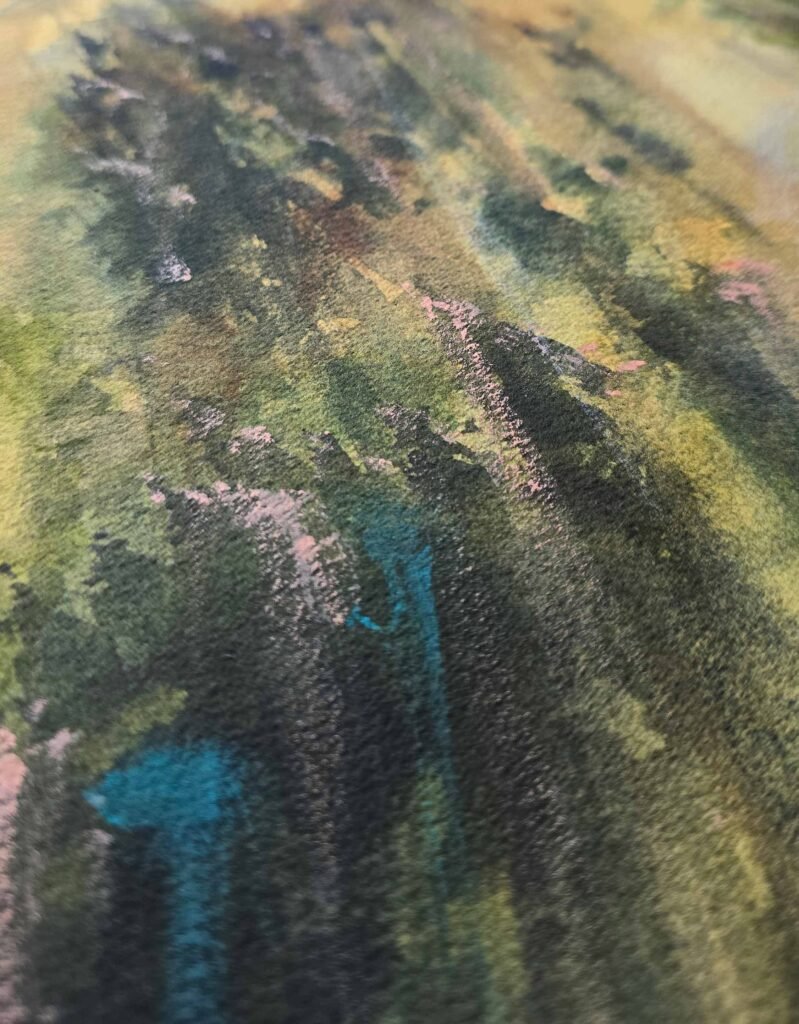
This uncertainty became an important part of developing the original watercolour painting. Rather than describing every tree individually, I worked with overlapping washes, variations of green and areas of concentrated pigment. Deep greens and muted earth tones establish the darker woodland forms, while warmer yellow passages suggest sunlight filtering through the canopy. Small accents of blue and pink interrupt the dominant greens, introducing subtle changes in temperature and visual rhythm.
Watercolour allows these relationships to develop without every boundary being predetermined. Pigments settle into the texture of the paper, some edges remain distinct, while others soften or merge into neighbouring colours. The material itself creates transitions between forms that might otherwise appear separate.
The light is particularly important here. Although it has no physical substance, it becomes one of the strongest presences in the composition. It stretches across the forest floor, interrupts darker forms and creates a sense of space that cannot be explained by the trees alone.
What interested me was how something intangible could become so visually present, while the apparently solid forms of the woodland could seem to dissolve.
This is where Hundred Shades of Green connects to Chapter III, Presence.
For me, presence is not simply the act of being somewhere. It is also a particular quality of attention. The willingness to remain with what we see without immediately reducing it to something familiar, recognisable or already understood.
The forest offers no dramatic event or obvious transformation. Its complexity emerges through ordinary relationships between light, shadow, colour and space. Yet these relationships are never entirely fixed. A change in light would alter the shadows, shift the colours and transform the experience of the same place.
The landscape remains familiar, but our understanding of it becomes less certain.
03
ARTIST'S NOTE
The original watercolour "Hundred shades of green: an English forest at dawn" is available for £800.
If you feel this painting might belong with you, I’m always happy to talk about the work itself and the practical details of acquiring it.
You can reach me directly by email or WhatsApp.
“Perhaps looking closely is not always about seeing more clearly. Sometimes it is about discovering how much remains open to perception.”